The Hedgerow Year: A Calendar of Visible Change
Track the hedgerow year from a safe path, with a simple way to compare bare branches, fresh leaves, flowers, fruit and changes caused by cutting.
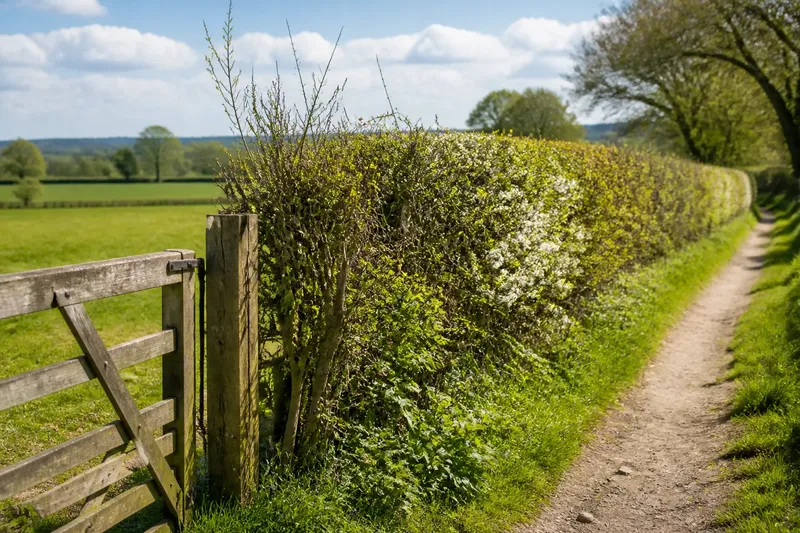
How can you follow a hedgerow year without naming or gathering plants? Choose one safe view from a public path and compare the hedge’s outline, openings and surface as the seasons change.
Imagine you pass the same mixed hedge on a familiar footpath. Choose a recognisable stretch, such as the section beside a gate, and note what is visible from the path. The aim is to see how this hedge changes, not to make claims about every hedge nearby.
Choose a fixed view
Find a viewpoint away from traffic and farm work, using a bend, gate or distinctive post to locate it again. Stay on the public path, leave room for others to pass, and do not lean through the hedge or enter a field.
Look at the whole section. Notice its outline against the field, the amount of sky visible through it, its meeting with a bank or ditch, and any openings. Record the date beside a few observations, or take a phone photograph from the same position. A notebook or phone is enough; plant names are not needed.
Make each note specific to the hedge’s shape: “open below the gate latch” or “green cover reaches the uneven top”. These details are easier to compare than a broad note such as “spring”. If you photograph it, keep people who have not agreed to be photographed out of the frame.
Read the winter frame
With leaves gone, the hedge’s framework comes into view: upright stems, crossing branches, cut ends and breaks. A bank or dip beside a drainage channel can make one part seem denser than another, so keep your viewing angle consistent.
Notice texture as well as gaps. One stretch may have fine twigs, while another shows thicker stems; fallen leaves caught in branches can soften the edge. Describe what you see without guessing why it is there.
Light changes the view. Branches may stand out against a bright sky and merge into the field in dull weather. If a photograph or note seems at odds with an earlier one, consider the light, rain and your position before deciding that the hedge itself has changed.
Follow the first green
Fresh colour can appear in patches before the hedge looks leafy as a whole. Note where it gathers: at the sunny top, near a sheltered corner or along the path-facing edge. Different plants and exposures make the change uneven, so there is no need to wait for the whole stretch to turn green.
Say you return after mild weather and see new green along the lower half, while the top still looks bare. Write down that contrast and revisit from the same spot later. If the upper outline has filled in, you have a clear record of change on this particular stretch.
Compare the summer edge
When leaves cover much of the framework, pay attention to the hedge’s surface. Is its edge crisp against the field, soft with overhanging growth, or interrupted by a gate? Can you still see into the interior, or has it become a more continuous screen?
Keep the comparison centred on appearance. A low sun may cast a long shadow across the verge, and rain may darken leaves, making the hedge look fuller. Note those conditions if they make a photograph hard to compare.
It is not worth trying to catalogue every leaf, flower or insect. That takes attention away from the seasonal outline and may tempt you to leave the path or disturb the hedge. A few consistent, hedge-specific observations are more useful.
Watch fruit and thinning
As leaves change colour or thin, flowers may be followed by visible fruit. Describe the broad pattern—clusters, scattered bright points or fruit mostly hidden by leaves—without touching, collecting or identifying it. What you can see depends on the density of the hedge and your angle.
Compare familiar openings and edges. Do gaps noted earlier show more clearly as leaves fall? Does the top remain covered while the lower edge opens? A single visit gives only one view: weather and recent cutting can affect what remains visible.
As leaves drop, compare the hedge with your winter notes. New growth, fallen branches or routine trimming may leave its outline different from the one you remember. Seasonal signs recur, but the hedge need not look exactly the same each year.
Questions about return visits?
How often should I revisit the hedge?
Return when your route allows, at intervals that make seasonal differences easy to notice. Consistency matters more than catching a precise moment of change.
Should I photograph the same view?
A repeated photograph helps compare outline and leaf cover if you stand in roughly the same place and face the same direction. Note rain or strong backlighting when either makes the image difficult to compare.
Can I observe without a notebook?
Yes, but a short written note makes details easier to recall. Use a phone reminder or calendar entry to prompt a return to the same viewpoint.
What if the hedge has been cut?
Note the new, even outline and any cut material you can see from the path. Treat the trim as part of the hedge’s changing appearance, then look for new growth on a later visit.
Keep comparisons clear
For a useful hedgerow year, keep the date and viewpoint with each note, then compare outline, openings, colour, leaf cover and fruit. The search phrase “hedgerow year” need not mean a formal survey: a few observations from a consistent, safe position can show how one stretch changes while leaving it undisturbed.