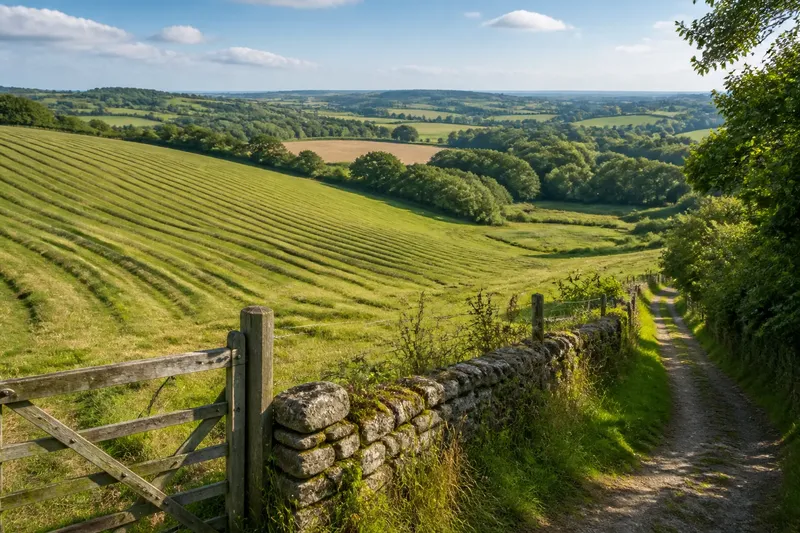
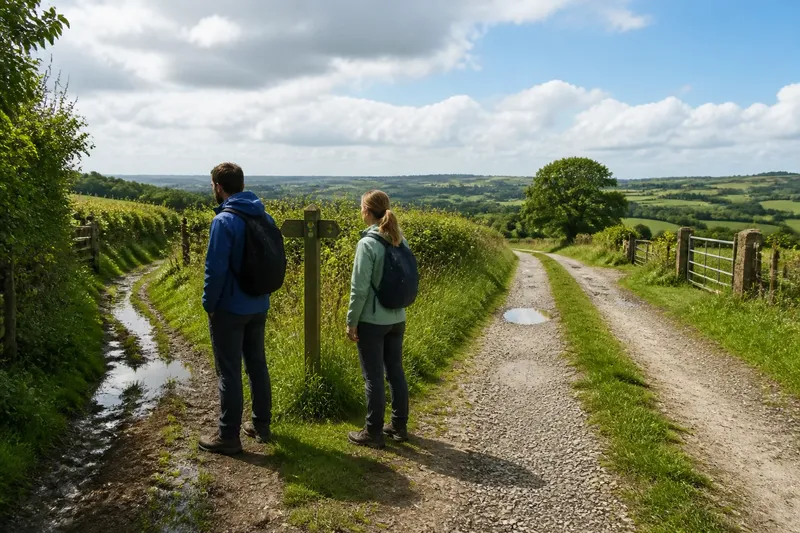
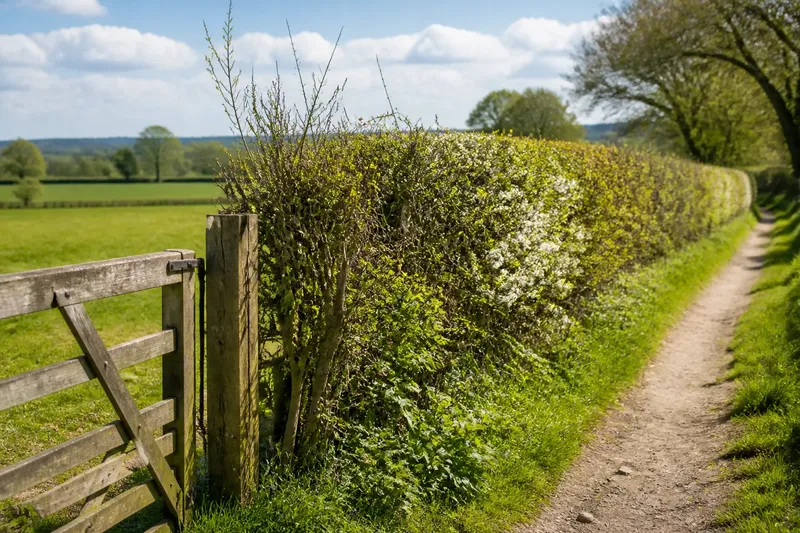
A Five-Minute Field Sketch That Keeps the Shape of a View
A five-minute field sketch captures land, route and horizon in a few clear strokes, helping you remember a view without polished drawing skills.
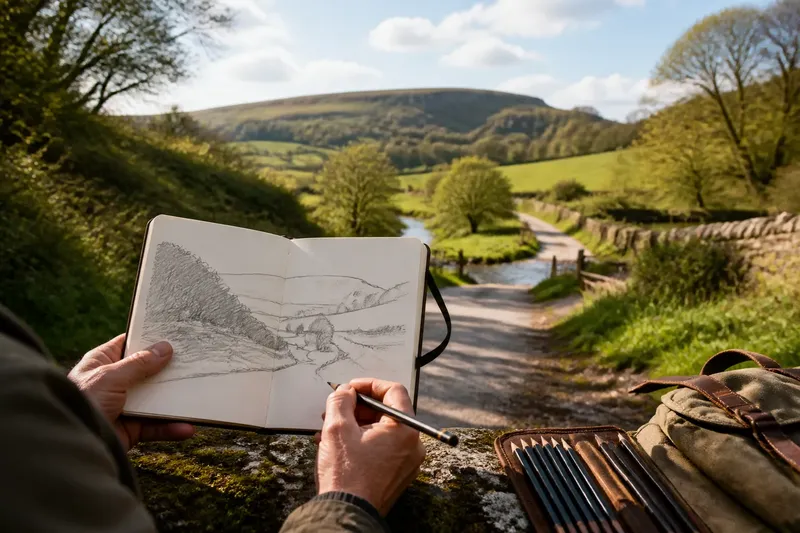
How do you remember the shape of a view after you have walked away? A five-minute field sketch gives you a quick way to capture the view’s silhouette: the rise of a ridge, the cut of a lane and the gaps between trees. Treat the page as a small composition, not a record of every feature.
Take a pocket notebook and pencil, then stop somewhere safe without blocking a path or standing in a vehicle entrance. Decide what makes the view recognisable, and let the rest go.
Build the silhouette
Begin with the skyline and the broad outline of the ground beneath it. Use one continuous, simple stroke for a hill or bank where possible. If trees break the skyline, draw their grouped outline rather than individual branches.
Next, add the largest dark or solid shapes: a wood, a building, a clump of trees or a steep bank. Leave white space between them. Those unmarked gaps can be as distinctive as the objects themselves, especially where a lane or valley opens towards the distance.
Keep the page loose. A light pencil line lets you shift a slope or building without turning the sketch into a polished drawing. The useful question is not “Does this look realistic?” but “Would I recognise the outline?”
Set a quick frame
Use this sequence when you want a compact sketch rather than a detailed scene:
- Choose a safe stopping place. Stand or sit clear of walkers, farm traffic and livestock. Stay on the path and away from crops and unstable edges.
- Mark the page shape. Draw a light rectangle or indicate the four corners. Choose a wide or tall frame according to the view’s strongest outline.
- Trace the skyline. Show the ridge, hill, tree line or buildings that divide land from sky. Keep this line simple enough to read at a glance.
- Block in large forms. Add the wood, bank, building or tree group as a plain outline or shaded patch. Do not add windows, branches or surface texture yet.
- Cut in the open shapes. Mark a gap between slopes, a notch in a hedge or the strip of sky above a roof. These spaces help preserve the composition.
- Check the silhouette. Compare the page with the view. If a large form or gap is in the wrong place, move it; if the outline reads clearly, stop.
For this exercise, the lane, wall or stream matters only when it changes the composition—for instance, when it slices across a bank or leads into a gap. It is not worth drawing every bend or boundary just because it is present.
Keep marks distinct
Give different shapes different kinds of marks. Use a firm outline for the nearest bank or roof, a lighter stroke for a distant ridge, and a broken edge where a tree group has openings. A few pencil strokes can distinguish forms without shading every surface.
For a dark wood against a pale field, lightly shade the wood as one mass. Leave the field blank. If two hills overlap, draw the nearer edge clearly and let the farther outline disappear behind it. That single interruption suggests depth without elaborate perspective.
When a shape is unclear, simplify rather than guess at its detail. A broad wedge can stand for a wooded slope; a shallow curve can mark a hollow. Add a short label only if you might otherwise misread the mark later.
What should you leave out?
Should I draw individual trees?
Only if one tree gives the view its distinctive outline. Otherwise, group trees into a single uneven mass and reserve separate marks for a prominent trunk or isolated tree.
How much shading is useful?
Use shading to separate one large form from another, not to copy every change in grass or foliage. If graphite starts to blur the skyline or the open gaps, stop shading and restore the outline.
What if the view does not fit?
Keep the feature that gives the scene its strongest silhouette and omit less distinctive edges. If the view changes as you move, make a separate small sketch from the new stopping place rather than combining two angles.
Do I need to label the drawing?
A short note can identify a shape that is hard to draw, such as “quarry face” or “church tower”. Add a place or viewpoint only if you know it; do not guess at names or directions.
Work through one view
Say you have five minutes at a bend where a wooded bank rises on the left, a narrow lane drops towards a stream, and a low ridge closes the far view. Start with the ridge as a shallow line across the upper part of the page. Add the bank as a dark wedge on the left, then leave a narrow pale gap between its edge and the ridge to show the valley opening. Draw the lane as two strokes narrowing towards the stream, but do not detail the crossing. Compare the sketch with the view: if the bank, opening and distant ridge sit in the right order, the page has kept the scene’s silhouette. If the lane dominates, lighten or shorten it so it does not overwhelm the larger shapes.
Check the composition?
- Skyline: Look for the main ridge or tree line. If it divides the page in a way that matches the view, keep it; if not, adjust the outline before adding detail.
- Large forms: Check whether the wood, building or bank occupies the right part of the frame. If its position is wrong, move or simplify it; otherwise, leave it alone.
- Open gaps: Look for a notch, valley or strip of sky between forms. If a distinctive gap is missing, erase a small area or redraw the neighbouring edges; if it is already clear, add nothing.
- Overlaps: Check which hill, tree group or roof sits in front. If the order is confusing, break the hidden outline where it disappears; if the layers read clearly, avoid extra shading.
- Dark and light: Compare the main masses with the open areas. If shading merges separate shapes, lift some graphite with an eraser; if the contrast is clear, stop adding tone.
- Frame edges: Check whether a close branch, wall or bank cuts into the view. If it forms a strong border, include a simple edge; if it does not shape the composition, omit it.
- Page balance: Look for a large blank area that should contain a major form, or a crowded area full of small marks. If either obscures the silhouette, remove minor detail or reposition a broad shape; if the outline reads, put the pencil away.
Keep a useful record
Write a brief note beside the sketch if it will help you identify the view later: a place name you know, a distinctive building or “from the bend above the stream”. The drawing itself should carry most of the information. Avoid lengthy descriptions that compete with the shapes on the page.
A field sketch does not need confident drawing or a full set of details. Capture the skyline, the largest forms and the open spaces that make the view recognisable; then stop while the composition is still clear. When you search for a five-minute field sketch, that is the practical aim: a quick silhouette you can read later, not a miniature landscape painting.