Thatched, Tiled and Slate Roofs: Why Country Rooflines Differ
Thatched, tiled and slate roofs reveal how local materials and building traditions shape rural skylines, and offer practical clues to read on a walk.
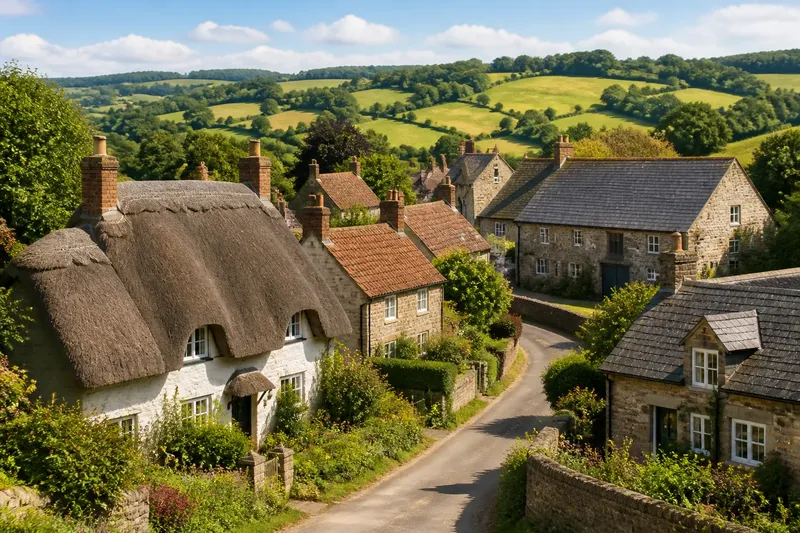
Why does one village have thick, rounded thatch while the next catches the light on slate or red tile? Thatched, tiled and slate roofs can offer clues to local materials, building skills and the changing uses of rural buildings. Their patterns are useful evidence, but they need to be read alongside the landscape and the buildings themselves.
Materials and supply
Roofing traditions often reflect what builders could obtain and work with, though the pattern varies by region and period. In parts of England where suitable clay was available and tile-making was established, clay tiles could be produced locally. In districts with workable slate deposits and the craft to split and shape the stone, slate became an option. Where cereal straw or other suitable plant material was available, thatching depended on both the harvest and skilled labour.
Nearby resources were only part of the story. Roads, waterways, estates and markets could bring materials from further away, while a village might use more than one covering at once. Treat the surrounding geology and farming as context, not proof of why a particular roof was chosen.
Look for transitions rather than a sharp boundary. Roof coverings may shift gradually along a route, with mixed materials and later replacements obscuring older patterns. A change in roof type can reflect supply, building date, ownership or subsequent repair; a single view rarely settles which explanation fits.
Roof coverings at a glance
- Thatch: A textured covering that can give the eaves a rounded profile. Plant material, local working methods and later repairs affect its appearance.
- Clay tile: Often seen in red or brown tones, with repeated courses. Colour and shape vary, and weathering can make identification less certain.
- Slate: Commonly forms a flatter, closely coursed surface, often in grey or blue-grey shades. The stone and the way it was cut alter its appearance.
- Stone slates: These are typically heavier and more irregular in outline than thin, uniform slate pieces, giving the roof a distinct rhythm.
These descriptions are visual clues, not a foolproof catalogue. Replacements, weathering and modern additions can complicate identification. Start with the overall texture and outline; avoid naming a material from colour alone.
Craft and roof edges
Materials do not dictate a roof’s appearance by themselves. Thatchers shape the outer coat and finish its edges; tilers lay units in repeated courses; slate workers arrange pieces to cover the roof planes and shed water. The methods leave different visual rhythms, though repairs can alter the original finish.
Look at the eaves, verges and ridges, where the outline is easiest to see. A crisp edge can make a building seem geometric, while a deeper, softer edge may merge into nearby walls and vegetation. Ridge finishes also vary, from simple lines to more decorative treatments.
Do not assign a roof covering to a fixed period or social group. Buildings are repaired, extended and re-roofed, so an older local preference may sit beside newer choices. Treat the roof as one clue among several, rather than a date stamp.
Shape and building use
Compare cottages, barns, farmhouses and larger houses in the same settlement. A gable has a triangular end; a hipped roof slopes down on more sides. Dormers, lean-tos and extensions make outlines more complex and may show how a building was adapted for another use.
Covering and shape work together visually. A broad roof with thick thatch may seem low and sheltering, while a steep roof with closely laid tiles can appear taller. A barn roof may dominate its walls because it spans a large working space. These impressions help explain a skyline without suggesting that every building should share one material.
Say you arrive in an invented village where older cottages have thatch and a converted farm building has slate. First, note the coverings and roof shapes separately. Next, compare the converted building with nearby barns and cottages, then check whether the lane approaches a road, stream or other route for supplies. The result is a cautious reading: the contrast could reflect different building histories or later changes, while the local supply pattern remains uncertain without more evidence.
Questions about country roofs?
Why do roofs change from village to village?
Settlements may differ in geology, crops, transport links and craft traditions. Even where materials overlap, builders may favour different forms or finishes.
Does a roof material reveal a building’s age?
It may suggest a regional tradition, but it cannot date a building by itself. Compare the covering with the building’s shape, visible alterations and neighbouring roofs.
Why are some rural roofs steep?
Roof pitch reflects design and local building practice, among other factors. A steep outline is a clue to observe, not a reliable way to identify a covering or explain a building’s history.
What should I notice first on a walk?
Look across several buildings and note the covering, roof shape and position in the settlement. Then watch for transitions along lanes or between houses and outbuildings.
Field notes for rooflines
- Check several buildings before deciding which covering seems typical; if they agree, note a local pattern, but if they differ, record the mix instead.
- Check colour and texture together; if both suggest the same covering, make a tentative note, but if they conflict, describe the appearance without naming it.
- Check whether the roof pattern changes near a road, stream, quarry or open farmland; if it does, note the location as context, but if it does not, avoid assuming supply explains the pattern.
- Check roof shape separately from its covering; if the same material appears on different forms, record both features, but if the view is unclear, leave the shape unidentified.
- Check for extensions and converted buildings; if a roof differs from its neighbours, note the alteration, but if no change is visible, do not infer a different building date from the covering alone.
- Check the eaves, verges and ridge from a safe public viewpoint; if the edge is clear, note its finish, but if it is hidden or distant, skip the detail rather than approach private property.
It is not worth trying to name every roofing tradition from a passing glimpse. A careful note such as “grey, closely coursed covering on a steep gable” is more useful than a confident guess based only on colour.
Thatched, tiled and slate roofs can help you read a country roofline, especially where one covering gives way to another. Record what you can see, then treat the surrounding land and settlement as context rather than a complete explanation; that distinction keeps a useful observation from becoming an unsupported claim.